Showing posts with label workouts. Show all posts

Thursday, 19 December 2013

Workout 'Power Through'

Want a workout that is challenging and yet does not require going to the gym? Here is one for you. Actually this one is for everyone! I love such workouts. The idea of AMRAP workouts it to do as many reps as YOU can for the time given. This means you are challenging your own capabilities. 


The 'Power Through' workout consists of 2 sets of exercises. Each set is repeated 3 times with 30 seconds rest in between the rounds. And each exercise goes for 45 seconds so set your timers! Do as many repetitions of each exercise as YOU can. Do not make it easy for yourself! But if you really need a break, you can stop for 5 - 10 seconds. 

Sequence 1

1. Switch kicks - Start from standing position. Elbows are bent and close to your body. Imagine there is someone in front of you and you have to kick him in the stomach. Kick with a straight leg, heel comes out. Switch legs in the air. To do that you need to use your core power. Therefore, keep your abs contracted! If you find switching legs in the air way too much for you, you can modify. Straighten the leg out and high, putting it back on the ground and repeat with the other leg. Do not forget to keep the core contracted

Do as many reps as you can for 45 seconds

2. Jump Squats - Get down in a squat position. Your feet are spread at least shoulder width apart or a little bit wider (depending on how flexible you are). Bent your knees until you come to 90 degrees. Make sure your knees stay behind your toes and not leaning in front. Your back should be flat, chest open and you are gazing in front of you. Chin also parallel to the floor. The centre of your weight is on the outside of your feet and on your heels.

From this position, push yourself off the ground with your feet, squeezing your gluteus and abs to help you with the jump. Jump with straight legs and land softly in the same squat position. AMRAP (as many reps as possible) for 45 seconds !

3.Oblique plank - Get down in a plank position. Your wrists are below your shoulders. Your body is in a straight line. (*Note: Make sure your butt is not too high or your hips are not dropping to the ground) Your core and inner thighs are contracted. Bring your right knee out and towards your body. Take the leg back to straight plank. Take the left knee out and towards your body. Take it back. Repeat. Do as many reps as you can for 45 seconds and do not forget to keep the right form !

4. Floor runs - After you are done with the oblique plank, keep the plank position. Bring one knee to your chest, put the leg back and repeat with the other knee. Like you are running with your palms on the floor. Do as many reps as you can for 45 seconds.


Rest for 30 seconds. Repeat the sequence 3 times in total

Sequence 2

1. 20x high knees + 4x push ups - From a standing position lift your right knee up above your hip. Switch with the other knee. Use your lower abs to lift the knees up. Always land softly to prevent injury. Do 20 repetitions and get down on the ground for 4 push ups. If you need modification of the push ups, perform them with knees on the ground. 

2. Burpees - From a standing position place your hands on the ground close to your feet. Jump your feet out and lay down on the ground. Jump your feet back in and jump up clapping your hands above your head. Make sure you are using your abs to help you jump. Do as many reps as you can in 45 seconds !

3. Triceps dips - Get yourself a chair next to a wall or use a step or something that can hold you. If you cannot find anything you can also do it on the ground. Place your palms on the chair (or floor) behind you with fingers pointing towards your body. Knees are bent and elbows straight. Bent your elbows as low as you can (without your butt reaching the ground) and push yourself up to straight arms again. Do as many reps as possible (AMRAP) for 45 seconds.


Rest 30 seconds. Repeat the sequence 3 times in total. 


Enjoy your workout and we are waiting for your comments !

Sunday, 8 December 2013

Bodyweight Interval Training

What I love about interval trainings is that it can never be too easy. Why? Because you have to go as fast as you can. So the stronger you become, the more reps you do. You get it? Now go get ripped with this 50:10 protocol bodyweight workout and nothing more !


4x Exercises 4x Rounds 50:10

The workout consists of only 4 exercises. Each exercise goes for 50 seconds followed by 10 seconds rest (the 50:10 protocol. We've done that before!) .You've got to go as fast as possible in these 50 seconds, kicking your heart rate go up. Make sure you breath a lot during the exercise and the 10 seconds of rest to get enough oxygen to your muscles. This is  very important when you are doing HIIT (Read more about High Intensity Interval Training).

Repeat the sequence for 4 rounds. Trying to score higher reps on each round. Together with the warm up it should last for about 20 minutes. It is also a good idea to stretch for 3 -5 minutes after the workout.

1. Jump Squats

Get down in a squat position. Your feet are spread at least shoulder width apart or a little bit wider (depending on how flexible you are). Bent your knees until you come to 90 degrees. Make sure your knees stay behind your toes and not leaning in front. Your back should be flat, chest open and you are gazing in front of you. Chin also parallel to the floor. The centre of your weight is on the outside of your feet and on your heels.

From this position, push yourself off the ground with your feet, squeezing your gluteus and abs to help you with the jump. Jump with straight legs and land softly in the same squat position. AMRAP (as many reps as possible) for 50 seconds ! Write down your scores.

2.Jump Lunges

Set up your lung position. From standing make step out with your right foot and bent your knees. The front knee is about your ankle at 90 degrees. The back knee is below the the hip also at 90 degrees. Do not bring the back knee too much to the back or to the front.

From this position, push yourself off the ground with your feet. Switch legs and land softly in the same position. The only different is that now your leg foot is in front and your right foot is back. Repeat the jump and switch. AMRAP for 50"! Write down your score

3. In&Out Abs

Get down in a plank position. Your shoulders are above your wrists. Neck is long. Your back is flat. Your legs are straight, so you are on your toes and palms. Maintain your body line straight. If you look yourself into the mirror, fro your head to your toes your body should be aligned in one line. Do not lift your butt or collapse your hips. In order to maintain straight body line you need to contract the abs. Work those abs ! They should be contracting during the whole time.

From the straight plank position, jump with your feet in, between your arms. Then jump them out, back into the straight plank position. Do as many reps as possible for 50" ! Write down your score

4. Triceps Dips

Get yourself a chair next to a wall or use a step or something that can hold you. If you cannot find anything you can also do it on the ground. Place your palms on the chair (or floor) behind you with fingers pointing towards your body. Knees are bent and elbows straight. Bent your elbows as low as you can (without your butt reaching the ground) and push yourself up to straight arms again. Do as many reps as possible (AMRAP) for 50". Write down your score


Try to perform better with every round. Even one rep more is an improvement! For a maximum recovery, take some good protein.


Thursday, 5 December 2013

This Is What Happens to Your Body When You Exercise

Have you been wondering what are the exact processes that happen in your body when you exercise ? Did you have an idea that your exercise is directly connected to increased brain functioning? Read this article to read about the positive benefits from exercising on your body and beyond... 

By Dr. Mercola
One of the key health benefits of exercise is that it helps normalize your glucose, insulin, and leptin levels by optimizing insulin/leptin receptor sensitivity. This is perhaps the most important factor for optimizing your overall health and preventing chronic disease.
But exercise affects your body in countless other ways as well—both directly and indirectly. Here, however, even the most unexpected side effects are almost universally beneficial. For example, side effects of exercise include but are not limited to:
  • Improved sexual function
  • Changes in gene expression
  • Clearer skin
  • Improved mood
  • Improved sleep
What Happens in Your Body When You Exercise?

 A number of biological effects occur, from head to toe, when you exercise. This includes changes in your:
  • Muscles, which use glucose and ATP for contraction and movement. To create more ATP, your body needs extra oxygen, so breathing increases and your heart starts pumping more blood to your muscles.
  • Without sufficient oxygen, lactic acid will form instead. Tiny tears in your muscles make them grow bigger and stronger as they heal.
  • Lungs. As your muscles call for more oxygen (as much as 15 times more oxygen than when you’re at rest), your breathing rate increases. Once the muscles surrounding your lungs cannot move any faster, you’ve reached what’s called your VO2 max—your maximum capacity of oxygen use. The higher your VO2 max, the fitter you are.
  • Heart. As mentioned, your heart rate increases with physical activity to supply more oxygenated blood to your muscles. The fitter you are, the more efficiently your heart can do this, allowing you to work out longer and harder. As a side effect, this increased efficiency will also reduce your resting heart rate. Your blood pressure will also decrease as a result of new blood vessels forming.
  • Brain. The increased blood flow also benefits your brain, allowing it to almost immediately function better. As a result, you tend to feel more focused after a workout. Furthermore, exercising regularly will promote the growth of new brain cells. In your hippocampus, these new brain cells help boost memory and learning. As stated in the featured article: 
    “When you work out regularly, your brain gets used to this frequent surge of blood and adapts by turning certain genes on or off. Many of these changes boost brain cell function and protect from diseases such as Alzheimer’s, Parkinson’s or even stroke, and ward off age-related decline.” 
    A number of neurotransmitters are also triggered, such as endorphins, serotonin, dopamine, glutamate, and GABA. Some of these are well-known for their role in mood control. Exercise, in fact, is one of the most effective prevention and treatment strategies for depression.
  • Joints and bones, as exercise can place as much as five or six times more than your body weight on them. Peak bone mass is achieved in adulthood and then begins a slow decline, but exercise can help you to maintain healthy bone mass as you get older.
  • Weight-bearing exercise is actually one of the most effective remedies against osteoporosis, as your bones are very porous and soft, and as you get older your bones can easily become less dense and hence, more brittle -- especially if you are inactive.

Your Brain Health Is Directly Related to Exercise

A related article published by Lifehacker.com focuses exclusively on brain-related changes that occur when you exercise. While I just mentioned that neurotransmitters, chemical messengers in your brain, such as mood-boosting serotonin, are released during a bout of exercise, that doesn’t account for all the benefits your brain reaps.

“If you start exercising, your brain recognizes this as a moment of stress. As your heart pressure increases, the brain thinks you are either fighting the enemy or fleeing from it. To protect yourself and your brain from stress, you release a protein called BDNF (Brain-Derived Neurotrophic Factor). This BDNF has a protective and also reparative element to your memory neurons and acts as a reset switch. That's why we often feel so at ease and like things are clear after exercising,” Leo Widrich writes.


Simultaneously, your brain releases endorphins, another stress-related chemical. According to researcher MK McGovern, the endorphins minimize the physical pain and discomfort associated with exercise. They’re also responsible for the feeling of euphoria that many people report when exercising regularly.

Scientists have been linking the benefits of physical exercise to brain health for many years, but recent research has made it clear that the two aren't just simply related; rather, it is THE relationship. The evidence shows that physical exercise helps you build a brain that not only resists shrinkage, but increases cognitive abilities. Exercise encourages your brain to work at optimum capacity by causing your nerve cells to multiply, strengthening their interconnections, and protecting them from damage. There are multiple mechanisms at play here, but some are becoming more well-understood than others.

The rejuvenating role of BDNF is one of them. BDNF activates brain stem cells to convert into new neurons. It also triggers numerous other chemicals that promote neural health. Further, exercise provides protective effects to your brain through:
  • The production of nerve-protecting compounds
  • Improved development and survival of neurons
  • Decreased risk of heart and blood vessel diseases
  • Altering the way damaging proteins reside inside your brain, which appears to slow the development of Alzheimer's disease 

Both Fasting ans Exercise Trigger Brain Rejuvenation 

Growing evidence indicates that both fasting and exercise trigger genes and growth factors that recycle and rejuvenate your brain and muscle tissues. These growth factors include BDNF, as just mentioned, and muscle regulatory factors, or MRFs.

These growth factors signal brain stem cells and muscle satellite cells to convert into new neurons and new muscle cells respectively. Interestingly enough, BDNF also expresses itself in the neuro-muscular system where it protects neuro-motors from degradation. (The neuromotor is the most critical element in your muscle. Without the neuromotor, your muscle is like an engine without ignition. Neuro-motor degradation is part of the process that explains age-related muscle atrophy.)

So BDNF is actively involved in both your muscles and your brain, and this cross-connection, if you will, appears to be a major part of the explanation for why a physical workout can have such a beneficial impact on your brain tissue. It, quite literally, helps prevent, and even reverse, brain decay as much as it prevents and reverses age-related muscle decay.

This also helps explain why exercise while fasting can help keep your brain, neuro-motors, and muscle fibers biologically young. Sugar suppresses BDNF, which also helps explain why a low-sugar diet in combination with regular exercise is so effective for protecting memory and staving off depression.


This Is Your Brain When You Exercise

BDNF and endorphins are two of the factors triggered by exercise that help boost your mood, make you feel good, and sharpen your cognition. As mentioned by Lifehacker, they’re similar to morphine and heroin in their action and addictiveness—but without any of the harmful side effects. Quite the contrary! So, how much do you have to exercise in order to maintain a sunnier disposition and better memory long-term?

According to a 2012 study published in the journal Neuroscience, the “secret” to increased productivity and happiness on any given day is a long-term investment in regular exercise. And a little each day appears to go further than a lot once or twice a week.

"Those who had exercised during the preceding month but not on the day of testing generally did better on the memory test than those who had been sedentary, but did not perform nearly as well as those who had worked out that morning,”the authors note.

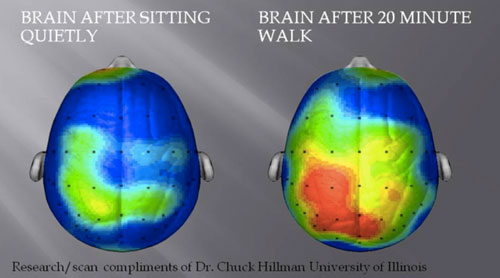
The reasons for this can perhaps be best perceived visually. Take a look at these images, showing the dramatic increase in brain activity after a 20 minute walk, compared to sitting quietly for the same amount of time.


There is a minor caveat, however. The researchers also discovered that exercise does not affect the brains of all people in exactly the same way. Some people, about 30 percent of people of European Caucasian descent, have a BDNF gene variant that hinders post-exercise BDNF production. The people with this BDNF variant did not improve their memory scores, even when exercising regularly, as significantly as those without this variant. Still, the research clearly suggests that—with individual variations as to the degree—regular exercise will cumulatively enhance your memory and other brain functions.


You Don’t Need to Train Like an Athlete to Reap the Benefits of Exercise

If you are sedentary there is hope for you. In her book, The First 20 Minutes: Surprising Science Reveals How We Can Exercise Better, Train Smarter, Live Longer, New York Times bestselling author Gretchen Reynolds addresses the issue of exercise as a way to improve longevity and happiness as well.

"The first 20 minutes of moving around, if someone has been really sedentary, provide most of the health benefits. You get prolonged life, reduced disease risk - all of those things come in in the first 20 minutes of being active,” she said in a 2012 interview.

Similarly, research published in 2008 found that those who exercised on work days experienced significantly improved mood on days that they exercised. Interestingly, while their mood remained fairly constant even on non-exercise work days, their sense of inner calm deteriorated on those days. According to the authors:

“Critically, workers performed significantly better on exercise days and across all three areas we measured, known as mental-interpersonal, output and time demands.”

Key findings included:

  • 72 percent had improved time management on exercise days compared to non-exercise days
  • 79 percent reported improved mental and interpersonal performance in exercise days
  • 74 percent said they managed their workload better
  • Those who exercised regularly also reported feeling more than 40 percent more “motivated to work” and scored more than 20 percent higher for concentration and finishing work on time
But remember, it is FAR better to exercise regularly. I believe it is also vital to engage in regular movement if you have a sitting job like most of us do, including me. I typically sit in front of a computer for more than 12 hours a day. What I have recently appreciated is that standing up every 10 minutes (with the help of a timer) and engaging in some type of brief exercise, is an enormously powerful habit to minimize the damage of long term sitting.


Aim for a Well-Rounded Fitness Program

Ideally, to truly optimize your health, you’ll want to strive for a varied and well-rounded fitness program that incorporates a wide variety of exercises. As a general rule, as soon as an exercise becomes easy to complete, you need to increase the intensity and/or try another exercise to keep challenging your body.

Additionally, more recent research has really opened my eyes to the importance of non-exercise movement. Truly, the key to health is to remain as active as you can, all day long, but that doesn’t mean you train like an athlete for hours a day. It simply means, whenever you have a chance to move and stretch your body in the course of going about your day—do it!

And the more frequently, the better. Everything from standing up, to reaching for an item on a tall shelf, to weeding in your garden and walking from one room to another, and even doing dishes count. In short, it’s physical movement, period, that promotes health benefits by the interaction your body gets with gravity. That said, I recommend incorporating the following types of exercise into your program:

  • Interval (Anaerobic) Training: This is when you alternate short bursts of high-intensity exercise with gentle recovery periods.
  • Strength Training: Rounding out your exercise program with a 1-set strength training routine will ensure that you're really optimizing the possible health benefits of a regular exercise program. You can also "up" the intensity by slowing it down.
  • Stand Up Every 10 Minutes. This is not intuitively obvious, but emerging evidence clearly shows that even highly fit people who exceed the expert exercise recommendations are headed for premature death if they sit for long periods of time. Personally, I usually set my timer for 10 minutes while sitting, and then stand up and do one legged squats, jump squats or lunges when the timer goes off. The key is that you need to be moving all day long, even in non-exercise activities.
  • Core Exercises: Your body has 29 core muscles located mostly in your back, abdomen and pelvis. This group of muscles provides the foundation for movement throughout your entire body, and strengthening them can help protect and support your back, make your spine and body less prone to injury and help you gain greater balance and stability.
  • Exercise programs like Pilates and yoga are also great for strengthening your core muscles, as are specific exercises you can learn from a personal trainer.
  • Stretching: My favorite type of stretching is active isolated stretches developed by Aaron Mattes. With Active Isolated Stretching, you hold each stretch for only two seconds, which works with your body's natural physiological makeup to improve circulation and increase the elasticity of muscle joints. This technique also allows your body to repair itself and prepare for daily activity. 


Sources & References:

Sunday, 10 November 2013

FINALLY! A WHOLE NATION REJECTS MCDONALDS

by Lance Johnson


McDonald's happy image and its golden arches aren't the gateway to bliss in Bolivia. 
This South American country isn't falling for the barrage of advertising and fast food cooking methods that so easily engulf countries like the United States. Bolivians simply don't trust food prepared in such little time. The quick and easy, mass production method of fast food actually turns Bolivians off altogether. Sixty percent of Bolivians are an indigenous population who generally don't find it worth their health or money to step foot in a McDonald's. Despite its economically friendly fast food prices, McDonald's couldn't coax enough of the indigenous population of Bolivia to eat their BigMacs, McNuggets or McRibs.

One indigenous woman, Esther Choque, waiting for a bus to arrive outside a McDonald's restaurant, said, "The closest I ever came was one day when a rain shower fell and I climbed the steps to keep dry by the door. Then they came out and shooed me away. They said I was dirtying the place. Why would I care if McDonald's leaves [Bolivia]?"

Fast food chain remained for a decade, despite losses every year


The eight remaining McDonald's fast food shops that stuck it out in the Bolivian city's of La Paz, Cochabamba, and Santa Cruz de la Sierra, had reportedly operated on losses every year for a decade. The McDonald's franchise had been persistent over that time, flexing its franchise's deep pockets to continue business in Bolivia.

Any small business operating in the red for that long would have folded and left the area in less than half that time. Even as persistent as McDonald's was in gaining influence there, it couldn't continue operating in the red. After 14 years of presence in the country, their extensive network couldn't hold up the Bolivian chain. Store after store shut down as Bolivia rejected the McDonald's fast food agenda. Soon enough, they kissed the last McDonald's goodbye.

Deep cultural rejection


The McDonald's impact and its departure from Bolivia was so lasting and important, that marketing managers immediately filmed a documentary called, "Why McDonalds's went broke in Bolivia."

Featuring, cooks, nutritionist, historians, and educators, this documentary breaks down the disgusting reality of how McDonald's food is prepared and why Bolivians reject the whole fast food philosophy of eating.

The rejection isn't necessarily based on the taste or the type of food McDonald's prepared. The rejection of the fast food system stemmed from Bolivian's mindset of how meals are to be properly prepared. Bolivians more so respect their bodies, valuing the quality of what goes into their stomach. The time it takes for fast food to be prepared throws up a warning flag in their minds. Where other cultures see no risk, eating McDonald's every week; Bolivians feel that it just isn't worth the health risk. Bolivians seek well prepared, local meals, and want to know that their food was prepared the right way.

This self respect helps Bolivians avoid processed "restructured meat technology," often used by fast food joints like McDonald's....

Read more foodmatters.tv ...

Wednesday, 24 April 2013

Top 5 Exercises to Look Fit, not just Slim

In what stage are you: loosing weight, getting big muscles or maybe just looking fit? Well, this article is for those of you who have already slimmed down and are now looking for that great fit look...

How to Look not just Slim but Fit

There are many people that mistake the two
concepts of 'being slim/skinny' and 'looking fit'. I have personally seen and talked to many ladies (especially ladies) that are slim and have no muscles, believing that loosing more weight will give them the desired look. Well ladies...this is not the case! Get some muscle there! You do not need to look like a fitness model or a bodybuilder (by the way, there is no way this can happen unless you put it as your goal) to be looking good and fit. And forget about the skinny fashion models... Fit Is the New Sexy! 

How often should I train to look fit?

In order to look good and have some muscle (notice I say 'some' and not 'a lot' for those who are scared of getting muscular), you need to exercise at least 5-6 times per month for the beginners. This frequency of training will help you build some strength in your muscles and make them more tight. If you have already passed that level, you must increase to 2-3 times per week. You are going to feel the moment of transition yourself. There will be a moment when your muscles will be feeling it too easy and then you need to switch to the higher interval. For those of you who consider themselves "advanced", 3 - 6 times a week should be the best for you. It is always good to leave one day rest because otherwise your muscles "get used to" the workout and the effect is not the same.

What exercises should I do?

There are plenty of exercises that you can do to get your body toned and defined:

  • Squats - to define the glute
There are many types of squats you can do and they are THE exercise for a shaped bum and hips. Start with normal squats, later add weights and from then on you can start doing variations.

Variations: Sumo squats, Sumo squats with leg raise, Jumping Squats, etc. 
  • Lunges - also for glute and hips
Variations: Walking lunges, Front lunges on spot, Backside lunges, Back and Front lunges. Add weights !
  • Push-Ups - for nice arms, shoulders and abs
Push ups are also a great exercise to add definition. They target various muscles so with one shot, you get more. It is a good idea to start with your knees on the ground. Later you can lift your knees up and from then on: 

Variations: Cross Leg push ups, Reptile push ups, try decreasing the distance between your hands, etc.
  • Planks - for abs
I like doing planks. It builds strength in your muscles. Start with a normal plank but once you feel it is not a real challenge to keep it for one minute, start changing the variations:

Variations: Shoulder touch plank, Reptile plank, Side plank, Up and Down Plank
  • Burpees - for the whole body
Burpees make many muscle groups in your body to contract and they also have a cardio effect. It is kind of an advanced move but the sooner you get used to including them in your workout, the better for your shape! And this is what we want right? I nice body shape...


So, these are my top favourite toning, muscle defining exercises for a fit look. What do you do to get them muscles visible?