Showing posts with label Articles. Show all posts

Wednesday, 22 January 2014

Exercise Found to Be Equal to Drugs For Heart Disease &Diabetes


By Dr. Mercola

One of the key health benefits of exercise is that it helps normalize your glucose, insulin, and leptin levels by optimizing insulin and leptin receptor sensitivity. This is perhaps the most important factor for optimizing your overall health and preventing chronic disease, and may explain why exercise is such a potent preventive medicine.

In fact, researchers recently suggested that exercise is "the best preventive drug" for many common ailments, from psychiatric disorders to heart disease, diabetes, and cancer. According to Jordan Metzl, a sports-medicine physician at New York City's Hospital for Special Surgery and author of The Exercise Cure:

"Exercise is the best preventive drug we have, and everybody needs to take that medicine."


And, as stated by Dr. Timothy Church, director of preventive medicine research at the Pennington Biomedical Research Center in Baton Rouge:

"Exercise strengthens the entire human machine — the heart, the brain, the blood vessels, the bones, the muscles. The most important thing you can do for your long-term health is lead an active life."


Get Up And Move - Your Health Depends On It

Unfortunately, many fail to get sufficient amounts of exercise. Worse yet, a majority of people may still endanger their health simply by sitting too much. Compelling evidence actually suggests that even if you exercise regularly, prolonged sitting is itself a risk factor for chronic disease and reduced lifespan...

Overall, federal data suggests only 21 percent of American adults meet the government recommendation to engage in two and half hours' worth of aerobic and muscle-strengthening exercise each week, so there's clearly a lot of room for improvement.  Ideally though, you'll want to exercise regularly AND frequently interrupt your sitting in order to optimize your health and longevity. I'll review the reasons for this below.

Forget The Drugs - Exercise Can Equally Help Prevent Diabetes And Heart Disease
A recent meta-review conducted by researchers at Harvard and Stanford compared the effectiveness of exercise versus drug interventions on mortality outcomes for diabetes, coronary heart disease, heart failure, and stroke.

After reviewing 305 randomized controlled trials, which included nearly 339,300 people, they found "no statistically detectable differences" between physical activity and medications for prediabetes and heart disease.

This is a potent reminder of the power of simple lifestyle changes, as well as the shortcomings of the drug paradigm! 

Besides optimizing insulin/leptin receptor sensitivity, other beneficial biochemical changes also occur during exercise, including alterations in more than 20 different metabolites involved in fat burning and metabolism, among other things. As stated by Dr. Church, exercise indeed affects your entire body—from head to toe—in beneficial ways. This includes changes in your: 

Muscles
Muscles use glucose and ATP for contraction and movement. Tiny tears in your muscles make them grow bigger and stronger as they heal. Gaining more muscle through resistance exercises has many benefits, from losing excess fat to maintaining healthy bone mass and preventing age-related muscle loss as you age. The intensity of your resistance training can achieve a number of beneficial changes on the molecular, enzymatic, hormonal, and chemical level in your body. 

Lungs
As your muscles call for more oxygen, your breathing rate increases. The higher your VO2 max—your maximum capacity of oxygen use—the fitter you are.

Heart
Your heart rate increases with physical activity to supply more oxygenated blood to your muscles. The fitter you are, the more efficiently your heart can do this, allowing you to work out longer and harder. Your blood pressure will also decrease as a result of new blood vessels forming.

Brain
The increased blood flow also benefits your brain, allowing it to almost immediately function better. Exercising regularly also promotes the growth of new brain cells, boosting your capacity for memory and learning. A number of neurotransmitters are also triggered, such as endorphins, serotonin, dopamine, glutamate, and GABA. Some of these are well-known for their role in mood control. Exercise, in fact, is one of the most effective prevention and treatment strategies for depression.

Joints and Bones
Exercise can place as much as five or six times more than your body weight on them. Weight-bearing exercise is one of the most effective remedies against osteoporosis, as your bones are very porous and soft, and as you get older, your bones can easily become less dense and hence, more brittle -- especially if you are inactive. 


For Optimal Benefits, Make Sure You're Exercising Correctly

I've often equated exercise to a drug from the perspective that they both need to be wisely prescribed in order to optimize your health. Simply doing random exercises for the sake of "exercising" will not achieve the benefits you seek. In fact it could cause serious injury, especially if you engage in strength training with poor form and no coaching. In terms of "dosage," it's important to note the changes in recommendations that have taken place over the past few years. While conventional aerobic exercise was long considered the "gold standard" of a good workout, research has refuted such notions.

Instead, high-intensity interval training (which requires but a fraction of the time compared to conventional cardio) has been shown to be FAR more efficient and effective, compared to longer, slower cardio workouts. In fact, exercises such as long distance running have been shown to be among the worst forms of exercise, in terms of health benefits.

The reason for this is quite simple. High intensity interval training (HIIT) mimics the movements of our hunter-gatherer ancestors, which included short bursts of high-intensity activities, but not long-distance running. This, researchers say, is what your body is hard-wired for. Basically, by exercising in short bursts, followed by periods of recovery, you recreate exactly what your body needs for optimum health. Twice-weekly sessions, which require no more than 20 minutes from start to finish, can help you:

  • Lower your body fat
  • Improve your muscle tone
  • Boost your energy and libido
  • Improve athletic speed and performance

Naturally increase your body's production of human growth hormone (HGH)—a synergistic, foundational biochemical underpinning that promotes health and longevity. Conventional cardio will NOT boost your HGH level


The Importance of Non-Exercise Movement

Next, let's address the issue of non-exercise movement. I also like to call this intermittent movement. This is the latest area of physical activity that's gaining a lot of attention, and for good reason. Studies have repeatedly found strong correlations between prolonged sitting or inactivity and reduced life expectancy—even if you exercise regularly!


It appears that temporary vigorous exercise simply cannot compensate for the damage incurred by prolonged daily sitting. For example, a recent analysis of 18 studies, found that those who sat for the longest periods of time were twice as likely to have diabetes or heart disease, compared to those who sat the least. An earlier study that highlighted much of the recent evidence linking sitting with biomarkers of poor metabolic health, also found that total sitting time correlates with an increased risk of type 2 diabetes, heart disease, and other prevalent chronic health problems—even if you exercise regularly.

The answer, fortunately, is quite simple. You just need to make sure you move your body more often. Simply standing up from a seated position has been found particularly effective at counteracting the ill effects of sitting. This is something I seek to do every 15 minutes while I am sitting. I set a timer to remind me. When the timer rings I get up and do some simple hamstring or chest stretches for a minute or two. I am testing a variety of different ones and hope to report on them later this year.

Earlier this year, I interviewed Dr. Joan Vernikos, former director of NASA's Life Sciences Division and author of Sitting Kills, Moving Heals, on this topic. Her groundbreaking research reveals why standing up is such an effective remedy—it's because when you stand up, your body acts against gravity. Sitting actually simulates a low-gravity type environment for your body, and your body deteriorates at a far more rapid pace in anti-gravity situations... Hence, the remedy is to continuously engage in physical movements, as this increases the forces of gravity on your body.

Simple everyday activities such as housecleaning, cooking, gardening, hanging clothes to dry, bending over to pick up a stray sock, reaching for an item on a high shelf, all fall within the spectrum of movements you would ideally engage in—more or less continuously—from morning until night. To learn more about this important aspect of health, please see this previous article.


*Find the full article here: http://foodmatters.tv/articles-1/exercise-found-to-be-equal-to-drugs-for-heart-disease-diabetes

Tuesday, 31 December 2013

Did you write down your New Year's Resolutions? Because you should!

Inevitably we are again at this moment of the year when we normally get these thoughts about what we would like to achieve or change in the coming year. Here is how to make these thoughts become a reality...


Spend 15 mins of your time alone
Find 15 minutes of your time to just sit down in a room by yourself and contemplate on the things you would like to achieve/change. Are you not completely satisfied with your physical performance? Think about what is hindering you from your goal. Maybe you have not tried quitting fast food or you do not get enough sleep. Probably you would like to get that car you really want but you do not have money? Think about the different aspects of your life and identify the things you desire most

Write them down on a paper
I know some of you might think this is a cliché but is not! I have experienced it myself. Often I write down my goals on a piece of paper and I stick the papers on the mirror in my room. Sooner or later these turn to become a reality. Once you see your goal written down black and white, you see it suddenly starts seeming more real than it was before that. So, write down all things you would like to change. No matter how simple they are. For instance, "I am going to bed 30 minutes earlier", "I am eating healthy foods " or "I am eating healthier than before ", "I am managing my money wisely". Pay attention and use affirmative words and tenses. Make it sound like it is already a reality and you are half way there !

Even better - visualize them with pictures !
My favourite is though the method of using pictures. I was just thinking about this and a friend of mine told me he put a picture of the MMA club in his car because he wants to start practising it and be good at it. Great! You can put pictures on your wall, mirror, change your desktop background with a picture of your desire (or make a collage!). Chose where to place the pictures strategically - where you will know you will be looking at them every day. If you have a fitness model or someone with a great physique that you admire, put a picture of him/her as a background of your phone. It is that simple!

What are your ways to make New Year's resolutions? If you have some, please, share with us. 

Affirm your goals by sharing them with us!

Saturday, 14 December 2013

Food Supplements: 6 Good Reasons to Take Them

From personal experience, I have found out that people who do not use supplements is because they do not have a good opinion about them. Supplements are not only the powders and pills bodybuilders take. Supplements can be taken from anyone for various reasons. The purpose of the supplements is to supplement your diet: they provide your diet with what it is missing. Why do I think your diet might be missing anything??? Read below...


1. Insufficient nutrients in our food

I am sure this is not the first time you are hearing this. But now it is time to start paying attention to this fact. The food we buy nowadays does not come from grandma's garden as it used too. It comes from green houses and genetically modified crops, seeds, etc. A tomato you buy at the local supermarket chain does not contain the same nutrient values as a tomato grown in your private garden (nor it tastes like one!). The fruit does not contain the same amount of vitamins and anti-oxidants. The levels of minerals and the quality of the fats is not the same. This is why do not get surprised if you still get sick sometimes although you do eat a lot of veggies and fruit. Here is one good reason everyone has to take supplements - to give to the organism the amount of nutrients it needs to be healthy and to function properly. 

2. Poor food preparation 

Here is another reason which has come just as the first one because of the technological developments. I really like gadgets and technologies but, damn, I do not like the commercial ways in which they are used. Do you have an idea how many households in your country have microwaves? In the two countries I live probably 95% of the households do own one!(1) Did you also know that warming up at a high-temperature in the microwave can "kill" the nutrients in your food (2)? Next time when you decide to use the microwave make sure you at least put it at a lower temperature or just use the stove instead. 

3. Obesity / Weight Loss

Now, this is important. I guess some of you might be immediately thinking about those pills that promise you to lose weight whatever you do - workout or not, eating well or not. Let's clear this up. It is impossible to lose weight if you keep on eating the wrong things. When you want to lose weight, you need to increase the amount of protein intake. Protein helps you keep the muscle while you are burning the fat and, according to some researches(3), satisfies hunger better than carbohydrates. Therefore, supplementing your diet with protein helps you lose more weight and get a fit and healthy look. 


4. Athletic performance

Athletes need to perform. And in order to perform at the highest of their abilities, they need fuel. Food is the fuel of the body. It gets stored in the body in the form of glycogen. So getting some calories before a training is important to increase performance. Supplements can give you the right amount of calories right before the workout without making you feel heavy.

Another reason why athletes take supplements is because they need a higher amount of protein to replenish their body and recover their muscles after trainings.(4)

5. Bad Sleep


There are also natural food supplements that can help you sleep better. The good sleep is vital for your body functions! When you sleep deep you get increased mental performance, focus and increased metabolic rate. The latter means that you also burn more calories during the day. Therefore, you should tackle your insomnia problems if you are aiming to lose weight as well as if you have any kind of stress in your life. 


6. Hormone imbalances


Many males have insufficient levels of the male hormone testosterone and this prevents them from gaining muscle mass. On the other hand, the exceeded levels of the female hormone estrogen in both women and men is what makes it hard to lose the extra fat. 


Do you have your 'stubborn' areas? Meaning do you have areas that seem to be keeping the fat more than other parts of your body? Depending on which is the stubborn part of your body, you can define which hormone is imbalanced. Therefore, taking the right supplement in this case is crucial for losing the stubborn fat. (5)


Tip: Always check out the labelling when you buy supplements you have not used before. It is an idea to also check out internet about opinions of people who have used the brand. Make sure you take natural supplements, like the ones you can find here: http://www.mywinwebpage.com/92561/index.aspx


References:
1) More than 90% of the American households do own at least one microwave: http://www.housewares.org/pdf/mw/mw_v3n4.pdf


Thursday, 5 December 2013

This Is What Happens to Your Body When You Exercise

Have you been wondering what are the exact processes that happen in your body when you exercise ? Did you have an idea that your exercise is directly connected to increased brain functioning? Read this article to read about the positive benefits from exercising on your body and beyond... 

By Dr. Mercola
One of the key health benefits of exercise is that it helps normalize your glucose, insulin, and leptin levels by optimizing insulin/leptin receptor sensitivity. This is perhaps the most important factor for optimizing your overall health and preventing chronic disease.
But exercise affects your body in countless other ways as well—both directly and indirectly. Here, however, even the most unexpected side effects are almost universally beneficial. For example, side effects of exercise include but are not limited to:
  • Improved sexual function
  • Changes in gene expression
  • Clearer skin
  • Improved mood
  • Improved sleep
What Happens in Your Body When You Exercise?

 A number of biological effects occur, from head to toe, when you exercise. This includes changes in your:
  • Muscles, which use glucose and ATP for contraction and movement. To create more ATP, your body needs extra oxygen, so breathing increases and your heart starts pumping more blood to your muscles.
  • Without sufficient oxygen, lactic acid will form instead. Tiny tears in your muscles make them grow bigger and stronger as they heal.
  • Lungs. As your muscles call for more oxygen (as much as 15 times more oxygen than when you’re at rest), your breathing rate increases. Once the muscles surrounding your lungs cannot move any faster, you’ve reached what’s called your VO2 max—your maximum capacity of oxygen use. The higher your VO2 max, the fitter you are.
  • Heart. As mentioned, your heart rate increases with physical activity to supply more oxygenated blood to your muscles. The fitter you are, the more efficiently your heart can do this, allowing you to work out longer and harder. As a side effect, this increased efficiency will also reduce your resting heart rate. Your blood pressure will also decrease as a result of new blood vessels forming.
  • Brain. The increased blood flow also benefits your brain, allowing it to almost immediately function better. As a result, you tend to feel more focused after a workout. Furthermore, exercising regularly will promote the growth of new brain cells. In your hippocampus, these new brain cells help boost memory and learning. As stated in the featured article: 
    “When you work out regularly, your brain gets used to this frequent surge of blood and adapts by turning certain genes on or off. Many of these changes boost brain cell function and protect from diseases such as Alzheimer’s, Parkinson’s or even stroke, and ward off age-related decline.” 
    A number of neurotransmitters are also triggered, such as endorphins, serotonin, dopamine, glutamate, and GABA. Some of these are well-known for their role in mood control. Exercise, in fact, is one of the most effective prevention and treatment strategies for depression.
  • Joints and bones, as exercise can place as much as five or six times more than your body weight on them. Peak bone mass is achieved in adulthood and then begins a slow decline, but exercise can help you to maintain healthy bone mass as you get older.
  • Weight-bearing exercise is actually one of the most effective remedies against osteoporosis, as your bones are very porous and soft, and as you get older your bones can easily become less dense and hence, more brittle -- especially if you are inactive.

Your Brain Health Is Directly Related to Exercise

A related article published by Lifehacker.com focuses exclusively on brain-related changes that occur when you exercise. While I just mentioned that neurotransmitters, chemical messengers in your brain, such as mood-boosting serotonin, are released during a bout of exercise, that doesn’t account for all the benefits your brain reaps.

“If you start exercising, your brain recognizes this as a moment of stress. As your heart pressure increases, the brain thinks you are either fighting the enemy or fleeing from it. To protect yourself and your brain from stress, you release a protein called BDNF (Brain-Derived Neurotrophic Factor). This BDNF has a protective and also reparative element to your memory neurons and acts as a reset switch. That's why we often feel so at ease and like things are clear after exercising,” Leo Widrich writes.


Simultaneously, your brain releases endorphins, another stress-related chemical. According to researcher MK McGovern, the endorphins minimize the physical pain and discomfort associated with exercise. They’re also responsible for the feeling of euphoria that many people report when exercising regularly.

Scientists have been linking the benefits of physical exercise to brain health for many years, but recent research has made it clear that the two aren't just simply related; rather, it is THE relationship. The evidence shows that physical exercise helps you build a brain that not only resists shrinkage, but increases cognitive abilities. Exercise encourages your brain to work at optimum capacity by causing your nerve cells to multiply, strengthening their interconnections, and protecting them from damage. There are multiple mechanisms at play here, but some are becoming more well-understood than others.

The rejuvenating role of BDNF is one of them. BDNF activates brain stem cells to convert into new neurons. It also triggers numerous other chemicals that promote neural health. Further, exercise provides protective effects to your brain through:
  • The production of nerve-protecting compounds
  • Improved development and survival of neurons
  • Decreased risk of heart and blood vessel diseases
  • Altering the way damaging proteins reside inside your brain, which appears to slow the development of Alzheimer's disease 

Both Fasting ans Exercise Trigger Brain Rejuvenation 

Growing evidence indicates that both fasting and exercise trigger genes and growth factors that recycle and rejuvenate your brain and muscle tissues. These growth factors include BDNF, as just mentioned, and muscle regulatory factors, or MRFs.

These growth factors signal brain stem cells and muscle satellite cells to convert into new neurons and new muscle cells respectively. Interestingly enough, BDNF also expresses itself in the neuro-muscular system where it protects neuro-motors from degradation. (The neuromotor is the most critical element in your muscle. Without the neuromotor, your muscle is like an engine without ignition. Neuro-motor degradation is part of the process that explains age-related muscle atrophy.)

So BDNF is actively involved in both your muscles and your brain, and this cross-connection, if you will, appears to be a major part of the explanation for why a physical workout can have such a beneficial impact on your brain tissue. It, quite literally, helps prevent, and even reverse, brain decay as much as it prevents and reverses age-related muscle decay.

This also helps explain why exercise while fasting can help keep your brain, neuro-motors, and muscle fibers biologically young. Sugar suppresses BDNF, which also helps explain why a low-sugar diet in combination with regular exercise is so effective for protecting memory and staving off depression.


This Is Your Brain When You Exercise

BDNF and endorphins are two of the factors triggered by exercise that help boost your mood, make you feel good, and sharpen your cognition. As mentioned by Lifehacker, they’re similar to morphine and heroin in their action and addictiveness—but without any of the harmful side effects. Quite the contrary! So, how much do you have to exercise in order to maintain a sunnier disposition and better memory long-term?

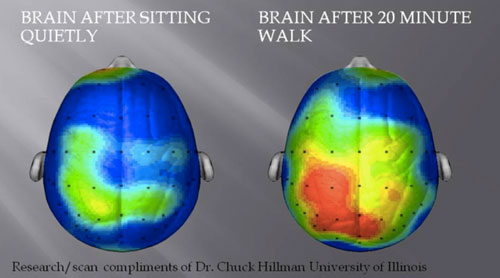
According to a 2012 study published in the journal Neuroscience, the “secret” to increased productivity and happiness on any given day is a long-term investment in regular exercise. And a little each day appears to go further than a lot once or twice a week.

"Those who had exercised during the preceding month but not on the day of testing generally did better on the memory test than those who had been sedentary, but did not perform nearly as well as those who had worked out that morning,”the authors note.

The reasons for this can perhaps be best perceived visually. Take a look at these images, showing the dramatic increase in brain activity after a 20 minute walk, compared to sitting quietly for the same amount of time.


There is a minor caveat, however. The researchers also discovered that exercise does not affect the brains of all people in exactly the same way. Some people, about 30 percent of people of European Caucasian descent, have a BDNF gene variant that hinders post-exercise BDNF production. The people with this BDNF variant did not improve their memory scores, even when exercising regularly, as significantly as those without this variant. Still, the research clearly suggests that—with individual variations as to the degree—regular exercise will cumulatively enhance your memory and other brain functions.


You Don’t Need to Train Like an Athlete to Reap the Benefits of Exercise

If you are sedentary there is hope for you. In her book, The First 20 Minutes: Surprising Science Reveals How We Can Exercise Better, Train Smarter, Live Longer, New York Times bestselling author Gretchen Reynolds addresses the issue of exercise as a way to improve longevity and happiness as well.

"The first 20 minutes of moving around, if someone has been really sedentary, provide most of the health benefits. You get prolonged life, reduced disease risk - all of those things come in in the first 20 minutes of being active,” she said in a 2012 interview.

Similarly, research published in 2008 found that those who exercised on work days experienced significantly improved mood on days that they exercised. Interestingly, while their mood remained fairly constant even on non-exercise work days, their sense of inner calm deteriorated on those days. According to the authors:

“Critically, workers performed significantly better on exercise days and across all three areas we measured, known as mental-interpersonal, output and time demands.”

Key findings included:

  • 72 percent had improved time management on exercise days compared to non-exercise days
  • 79 percent reported improved mental and interpersonal performance in exercise days
  • 74 percent said they managed their workload better
  • Those who exercised regularly also reported feeling more than 40 percent more “motivated to work” and scored more than 20 percent higher for concentration and finishing work on time
But remember, it is FAR better to exercise regularly. I believe it is also vital to engage in regular movement if you have a sitting job like most of us do, including me. I typically sit in front of a computer for more than 12 hours a day. What I have recently appreciated is that standing up every 10 minutes (with the help of a timer) and engaging in some type of brief exercise, is an enormously powerful habit to minimize the damage of long term sitting.


Aim for a Well-Rounded Fitness Program

Ideally, to truly optimize your health, you’ll want to strive for a varied and well-rounded fitness program that incorporates a wide variety of exercises. As a general rule, as soon as an exercise becomes easy to complete, you need to increase the intensity and/or try another exercise to keep challenging your body.

Additionally, more recent research has really opened my eyes to the importance of non-exercise movement. Truly, the key to health is to remain as active as you can, all day long, but that doesn’t mean you train like an athlete for hours a day. It simply means, whenever you have a chance to move and stretch your body in the course of going about your day—do it!

And the more frequently, the better. Everything from standing up, to reaching for an item on a tall shelf, to weeding in your garden and walking from one room to another, and even doing dishes count. In short, it’s physical movement, period, that promotes health benefits by the interaction your body gets with gravity. That said, I recommend incorporating the following types of exercise into your program:

  • Interval (Anaerobic) Training: This is when you alternate short bursts of high-intensity exercise with gentle recovery periods.
  • Strength Training: Rounding out your exercise program with a 1-set strength training routine will ensure that you're really optimizing the possible health benefits of a regular exercise program. You can also "up" the intensity by slowing it down.
  • Stand Up Every 10 Minutes. This is not intuitively obvious, but emerging evidence clearly shows that even highly fit people who exceed the expert exercise recommendations are headed for premature death if they sit for long periods of time. Personally, I usually set my timer for 10 minutes while sitting, and then stand up and do one legged squats, jump squats or lunges when the timer goes off. The key is that you need to be moving all day long, even in non-exercise activities.
  • Core Exercises: Your body has 29 core muscles located mostly in your back, abdomen and pelvis. This group of muscles provides the foundation for movement throughout your entire body, and strengthening them can help protect and support your back, make your spine and body less prone to injury and help you gain greater balance and stability.
  • Exercise programs like Pilates and yoga are also great for strengthening your core muscles, as are specific exercises you can learn from a personal trainer.
  • Stretching: My favorite type of stretching is active isolated stretches developed by Aaron Mattes. With Active Isolated Stretching, you hold each stretch for only two seconds, which works with your body's natural physiological makeup to improve circulation and increase the elasticity of muscle joints. This technique also allows your body to repair itself and prepare for daily activity. 


Sources & References:

Sunday, 10 November 2013

FINALLY! A WHOLE NATION REJECTS MCDONALDS

by Lance Johnson


McDonald's happy image and its golden arches aren't the gateway to bliss in Bolivia. 
This South American country isn't falling for the barrage of advertising and fast food cooking methods that so easily engulf countries like the United States. Bolivians simply don't trust food prepared in such little time. The quick and easy, mass production method of fast food actually turns Bolivians off altogether. Sixty percent of Bolivians are an indigenous population who generally don't find it worth their health or money to step foot in a McDonald's. Despite its economically friendly fast food prices, McDonald's couldn't coax enough of the indigenous population of Bolivia to eat their BigMacs, McNuggets or McRibs.

One indigenous woman, Esther Choque, waiting for a bus to arrive outside a McDonald's restaurant, said, "The closest I ever came was one day when a rain shower fell and I climbed the steps to keep dry by the door. Then they came out and shooed me away. They said I was dirtying the place. Why would I care if McDonald's leaves [Bolivia]?"

Fast food chain remained for a decade, despite losses every year


The eight remaining McDonald's fast food shops that stuck it out in the Bolivian city's of La Paz, Cochabamba, and Santa Cruz de la Sierra, had reportedly operated on losses every year for a decade. The McDonald's franchise had been persistent over that time, flexing its franchise's deep pockets to continue business in Bolivia.

Any small business operating in the red for that long would have folded and left the area in less than half that time. Even as persistent as McDonald's was in gaining influence there, it couldn't continue operating in the red. After 14 years of presence in the country, their extensive network couldn't hold up the Bolivian chain. Store after store shut down as Bolivia rejected the McDonald's fast food agenda. Soon enough, they kissed the last McDonald's goodbye.

Deep cultural rejection


The McDonald's impact and its departure from Bolivia was so lasting and important, that marketing managers immediately filmed a documentary called, "Why McDonalds's went broke in Bolivia."

Featuring, cooks, nutritionist, historians, and educators, this documentary breaks down the disgusting reality of how McDonald's food is prepared and why Bolivians reject the whole fast food philosophy of eating.

The rejection isn't necessarily based on the taste or the type of food McDonald's prepared. The rejection of the fast food system stemmed from Bolivian's mindset of how meals are to be properly prepared. Bolivians more so respect their bodies, valuing the quality of what goes into their stomach. The time it takes for fast food to be prepared throws up a warning flag in their minds. Where other cultures see no risk, eating McDonald's every week; Bolivians feel that it just isn't worth the health risk. Bolivians seek well prepared, local meals, and want to know that their food was prepared the right way.

This self respect helps Bolivians avoid processed "restructured meat technology," often used by fast food joints like McDonald's....

Read more foodmatters.tv ...

Tuesday, 22 October 2013

High Intensity Interval Trainings (HIIT) or Why you should quit long-lasting gym workouts?

A few years ago I used to spend around an hour and a half in the gym working out. That was sometimes without the time for going there and coming back. Now my workouts rarely take more than 30 minutes of my time. I do them at home or in the nearby park (so I save money) and I am loving the results. Read more about High Intensity Interval Training and its benefits...

What is HIIT?

High Intensity Interval Trainings are short workouts, that might last from 4 to 30 minutes. It is a form of
workout that alternates high intensity anaerobic exercises with lower intensity (or recovery) periods. A warm up is required before the workout and is recommended to be followed up by some stretching to cool down. 


The Tabata method

Probably the most famous kind of HIIT is the Tabata method. After a study, Izumi Tabata found, according to him, the most effective regime of training. The Tabata method alternates 20 seconds of a maximum- intensity exercise with 10 seconds of rest for 4 minutes, or 8 cycles in total. According to the study, this method performed 4 times a week produces the same results as a steady state training performed 5 days a week.


Benefits from HIIT

1. Fat burner cardio effect

Actually HIIT trainings burn more calories than regular cardio exercises such as jogging ! Apart from being a great fat burner during the workout, this regimen kicks off your metabolism so good that you burn more calories also in the 24 hours after the workout!

2. Metabolic kick

The fact that you keep on burning calories up to 24 hours after the workouts, means your metabolism is constantly working like a Swiss watch. It keeps on burning calories from fat and you do not lose any muscle unlike regular cardio activities! Moreover, it stimulates your body to produce more of the human growth hormone, which is an awesome anti-ageing effect.

3. Aerobic / Anaerobic benefits

Most of the people find it hard to keep up when they are in the anaerobic zone. This is the moment when you feel like your heart is going to jump out any moment and you are gasping for breath. With a few weeks of an intensive interval training, you can improve your anaerobic abilities and your sport performance in general raises to higher levels - also when it comes to aerobic exercises. 

4. Efficient

Apart from being very effective, HIIT workouts are the best regimen for a busy schedule that most of us have. The workouts are short - they take between 4 - 30 minutes -  and you can perform them anywhere you want - in the gym, in the park, at home. This means you can do it Anytime and Anywhere! 

4. Cheap - No gym equipment needed

To do HIIT you do not really need any equipment. Many variations of HIIT use only the weight of the body. So, you basically need to get some comfortable shoes and sweaty pants and you are ready for an awesome workout. If you do want to add some weight, you can equip yourself with a set of dumbbells or a bar at home, which is still quite cheaper than a regular visitation at the gym. 

Example of a HIIT workout


An example of an awesome HIIT workout that uses the Tabata regimen will show you the super cardio effect of interval trainings. 


Now enjoy sweating and getting lean! 

 Sweat is fat crying :)


Resources:

Wednesday, 4 September 2013

Why and How to Recover properly after workouts

Learn techniques to quickly repair muscles, recover after a workout, and reduce post-workout stress
Rest and recovery is an essential part of any workout routine. Your after exercise recovery routine has a big impact on your fitness gains and sports performance and allows you to train much more effectively. Unfortunately, most people don't have an after exercise recovery plan. Here are some tips to get your post-workout plans on track.

Why Workout Recovery Is Important
Recovery after exercise is essential to muscle and tissue repair and strength building. This is even more critical after a heavy weight training session. A muscle needs anywhere from 24 to 48 hours to repair and rebuild, and working it again too soon simply leads to tissue breakdown instead of building. For weight training routines, never work the same muscles groups two days in a row.
There are many methods to recover but we are going to look through the general once and probably most important.Since there are people who are new to exercise or are training just for tonus and people who are Athletes and are training intensively we are going to split these two and give some quick advices.

New to Exercise
If you’re just starting out in exercise, it’s important that you build into it slowly to allow your body to adapt to the demands of sport. Maybe try exercising on two consecutive days, but have a rest on the third day. If you just keep going, without any rest, your body will soon start to fatigue and you’ll find it difficult to complete any exercise sessions.
If you have just started physical activity or performed a new exercise for the first time, you might be feeling a little sore or stiff but don’t start doubting all those promises of feeling better for exercising just yet. In most cases this is a reaction from your body as it tries to adapt to the new experience. Starting exercise or performing a new movement pattern can result in:

• Severe muscle soreness
• Muscle stiffness
• Decreases in strength
• Decreases in skill levels

The results you may be experiencing are referred to as Delayed Onset Muscle Soreness or DOMS for short. Although DOMS is not fully understood, it is thought that the feelings of stifness/soreness generally show up sometime after the exercise is performed (hence the ‘Delayed’), this can be as long as 12 hours after. DOMS may last from a couple of days or even up to a week or longer. It is suggested that some recovery strategies may help prevent or a least reduce some of the associated results. The more an activity is repeated, you are less likely to feel the effects DOMS, or to lesser extent.
More Experienced Athletes
For those who are more experienced exercisers and are maybe training for an event, rest and recovery is also vitally important. You may have heard of a term called ‘Progressive Overload’, the principles of which are as follows:
• Training is designed progressively to overload body systems and fuel stores
• If the training stress is insufficient to overload the body’s capabilities, no adaptations will occur.
• If the workload is too great (progressed too quickly/performed too often without adequate rest), then fatigue follows and subsequent performance will be reduced.
• Work alone is not enough to produce the best results; you need time to adapt to training stress.
• To encourage adaptation to training, it is important to plan recovery activities that reduce residual fatigue.
• The sooner you recover from fatigue, and the fresher you are when you undertake a training session, the better the chance of improving.

Plan your training carefully, include rest days where you let you’re body recover from the stress and begin to adapt to the training. Try thinking ahead to the race/event date, plan different sessions for each week. Maybe do a couple of weeks of more intensive and hard sessions, but follow that with an ‘easy week’ where you’re body can adapt to all the hard training you’ve been doing.


Recovery Strategies


Replace Fluids. You lose a lot of fluid during exercise and, ideally, you should be replacing it during exercise, but filling up after exercise is an easy way to boost your recovery. Water supports every metabolic function and nutrient transfer in the body and having plenty of water will improve every bodily function. Adequate fluid replacement is even more important for endurance athletes who lose large amounts of water during hours of sweating. (see article “WATER – no one can live without it!” there is more information on how to hydrate your body during and after exercise)


Eat Properly. After depleting your energy stores with exercise, you need to refuel if you expect your body to recover, repair tissues, get stronger and be ready for the next challenge. This is even more important if you are performing endurance exercise day after day or trying to build muscle. Ideally, you should try to eat within 60 minutes of the end of your workout and make sure you include some high-quality protein and complex carbohydrate.


Stretch. After a tough workout, consider gentle stretching. This is a simple and fast way to help your muscles recover.


Rest. Time is one of the best ways to recover from just about any illness or injury and this also works after a hard workout. Your body has an amazing capacity to take care of itself if you allow it some time. Resting and waiting after a hard workout allows the repair and recovery process to happen at a natural pace. It's not the only thing you can or should do to promote recovery, but sometimes doing nothing is the easiest thing to do.
I remember, back in the days, when I was training two times a day when I was preparing for a competition. After the morning workout we had e lunch and then took a nap for 30-60 minutes and you really feel much better and fresh for the next training session.

Perform Active Recovery. Easy, gentle movement improves circulation which helps promote nutrient and waste product transport throughout the body. In theory, this helps the muscles repair and refuel faster.


Have a Massage. Massage feels good and improves circulation while allowing you to fully relax. You can also try self-massage and Foam Roller Exercises for Easing Tight Muscles and avoid the heavy sports massage price tag.


Take an Ice Bath. Some athletes swear by ice baths, ice massage or contrast water therapy (alternating hot and cold showers) to recover faster, reduce muscle soreness and prevent injury. The theory behind this method is that by repeatedly constricting and dilating blood vessels helps remove (or flush out) waste products in the tissues.


How to use contrast water therapy: While taking your post-exercise shower, alternate 2 minutes of hot water with 30 seconds of cold water. Repeat four times with a minute of moderate temperatures between each hot-cold spray. If you happen to have a spa with hot and cold tubs available, you can take a plunge in each for the same time.

Get High Quality Sleep. While you sleep, amazing things are taking place in your body. Optimal sleep is essential for anyone who exercises regularly. During sleep, your body produces Growth Hormone (GH) which is largely responsible for tissue growth and repair.

Avoid Overtraining. One simple way to recovery faster is by designing a smart workout routine in the first place. Excessive exercise, heavy training at every session or a lack of rest days will limit your fitness gains from exercise and undermine your recovery efforts.

Use Visualization, Imagery and Meditation. Adding a mental practice to your workout routine can be a huge benefit for any athlete. Spending time practicing mental rehearsal or following a mindfulness meditation program can help process a calm, clear attitude and reduce anxiety and reactivity. Getting familiar with how your mind works, how thoughts can bounce around, and how you don't need to attach to any of them, is a wonderful way for an athlete to recover both mentally and physically.

Listen to Your Body for a Faster Recovery
The most important thing you can do to recover quickly is to listen to your body. If you are feeling tired, sore or notice decreased performance you may need more recovery time or a break from training altogether. If you are feeling strong the day after a hard workout, you don't have to force yourself to go slow. If you pay attention, in most cases, your body will let you know what it needs, when it needs it. The problem for many of us is that we don't listen to those warnings or we dismiss them with our own self talk ("I can't be tired, I didn't run my best yesterday" or "No one else needs two rest days after that workout; they'll think I'm a wimp if I go slow today.").


Keep it Strong !

Srouce:
http://www.ffnetwork.co.uk
http://sportsmedicine.about.com

Sunday, 1 September 2013

Don't forget to warm up, right? Why, how

Although most of the people have heard that it is good to warm up before exercising, many still do not realize how IMPORTANT it actually is and what kind of processes go in your body. So, here's a simple and clear explanation. I hope after reading this, you will NEVER FORGET to warm up anymore. 


Why do we need to warm up?

Imagine you are in a deep sleep and at 3 am the door bell starts ringing and you have to jump out of bed and into some decent clothes. This is the same stress your body goes through if you do not prepare it for an intensive sport activity. It would be better if you know you have 5 minutes to wake up before your visitor comes, right?

Warming up means doing light exercises before heavy sport and helps you perform on the best level your body could possibly do. Incorporating a warm-up routine before exercising (running, gym, hiit, skiing, etc) when you will be intensively using your muscles gives you these benefits:


  • Flexibility - Sends blood to all parts and muscles in your body, improving the blood circulation, which results in more flexibility in the muscles
  • Heart rate - the proper blood circulation protects the hearts and improves its activity during the main exercises. 
  • Agility - Muscles are enriched with oxygen and nutrients to help you not get tired too quickly during the main exercise activity
  • Prevents injuries - muscle warm up actually prevents from joint injuries
  • Temperature raise - a warm up routine raises the temperature of your body gradually, which prepares it to burn more calories
  • Mental preparation - light exercises beforehand help you prepare mentally for the main activity. In this way your concentration is most likely to improve


How long do I need to warm up ?

The warm up routine should normally last between 10 to 20 minutes

How to warm up?

The idea of the warming up process is that you gradually get to the high level of intensity required in the main sport activity. So, start with less intense exercises, such as stretch, slow jog, slow jump rope, bicycle - and gradually increase the tempo of the activity or change with faster jumps, high knees, jumping jacks. 

Stretching

When you stretch, make sure to stretch all muscles and warm up all your joints. 
Start with your neck, shoulders, elbows, wrists, waist, knees and ankles. Do circles  - 8 in one direction and then 8 in the other direction. 
Then, start stretching your arms and back for about  2 minutes. The cat stretch is a very good way to stretch your back. 

Expect soon available visual explanations. 


Continues with your legs. The muscles you should make sure to stretch are:
- quadriceps
- hamstrings
- inner thighs  
- calves 


You got it, right? Now keep it going.

L. 


Resources:
http://www.fitday.com/fitness-articles/fitness/exercises/why-you-should-always-be-warming-up-and-cooling-down-while-working-out.html#b
http://www.sparkpeople.com/community/ask_the_experts.asp?q=10
http://beta.active.com/articles/triathlon/the-real-reason-you-should-warm-up

Thursday, 22 August 2013

WATER – No one can live without it!


Many people doesn't realise how important water is to us. That's why I decided to extract and sum up in this article the most important information that you have to know about water and it's qualities.


Water – General Information
About 70% of the Earth's surface is covered by water, and the same amount in our body. Water is required for each of the metabolic processes, including the synthesis of proteins. If you exercise intensely, the simplest thing you can do to help your body is to drink more water. According to the common understanding 6-8 glasses of water is enough for one day. But people who are exercising regularly need more. Aim to drink at least 2-4 liters of water depending on your size and needs.
Water flushes toxins and residues from our body. It is especially important in high-protein diet as it helps to remove excess nitrogen, urea (a toxic compound) and ketone bodies.If you take a lot of food to gain muscle mass, then you need even more water to help the kidneys. Without enough water, the kidneys can not function fully. When this happens, part of the "load" is transferred to the liver. It processes the accumulated fat in the body for energy. If the liver is doing some of the work of the kidneys, your body burns less fat, ie instead of burning, your liver is occupied with other activities and begin to accumulate extra pounds. Contrary to popular belief, drinking water can actually help clear excess fluid. When water is taken infrequently or in small quantities, the body begins to think that there is a shortage and begins to store it to have a reserve in case of need. It is stored in extra cellular spaces and makes your skin look soft and fluffy


Water and Exercising
By drinking an adequate amount of water each day, you can ensure that your body has all it needs to maintain good health
Starting out hydrated is a good choice for morning exercisers. Drink water before your workout; you lose water while you exercise even without heavy perspiration. Ingesting at least a glass of pure water shortly after rising is a good way to hydrate your system. Adding a small squeeze of lemon for taste also helps stimulate the bowels to evacuate soon thereafter, which will help you feel more comfortable during your workout routine. 
Hydration is particularly important for the morning workout enthusiast. Remember, you’ve just awakened from a 8-to 10-hour fast. Because proper hydration improves the quality of your workout, reduces fatigue, reduces recovery time, and increases your level of satisfaction, it is especially important for you to hydrate yourself before as well as after your workout session. Keep in mind that thirst is not the best scale by which to measure whether or not you are well hydrated. If your urine is the color of lemonade, you’re doing well; if by chance it is leaning toward the color of apple juice, you need to reach for another glass of fluid. Also, some symptoms of dehydration are headache, poor concentration, tiredness, and constipation.  

Hydration during exercising 
If your workout is particularly long or your environment is hot and/or humid, just drinking plain water during your exercise may not be the best option.
Two hours of vigorous exercise can deplete the fuel supply (called glycogen) that your muscle cells use during vigorous activity. Drinking water alone won’t replenish that fuel. Assuming you can’t take a meal break in the middle of your marathon race, you may need something to drink that also contains carbohydrate for energy and to sustain performance. Commercial sports drinks containing 6% to 8% carbohydrate from various sugar sources are recommended for exercise events lasting longer than 1 hour
Likewise, when you sweat heavily for an extended period, you’re not losing just plain water. You’re also losing a significant amount of sodium, which needs to be maintained within a certain range to avoid potentially serious problems like exercise-induced hyponatremia (a serum sodium concentration <130 mEq/L), which can also occur if you drink too much plain water, in a short time period
For particularly long endurance workouts OR exercise sessions in hot and humid weather, one may need more than the Tolerable Upper Intake Level for sodium (2,300 milligrams daily). That's why commercial sports drinks are often recommended for athletes taking part in such endurance events
Avoid taking huge gulps of water, though, and avoid taking in too much water during a single break. For instance, you may feel full and hurt your workout if you chug 30 ounces of water during a break. Instead, gradually take in cold water throughout your exercise routine, because cold water is absorbed more quickly into your system than warm water or room temperature water. This is the most effective way to drink water during exercise.

Hydration after exercising
Once you finish working out, your body still needs water to replenish the levels that you lost during your exercise. In order to help your body regroup, you need to drink plenty afterward as well. In addition to water, you should try to drink a beverage that contains electrolytes, as you lose many of these during exercise. Regardless, you need to get fluids into your system to make sure that you help the muscle healing process and stay hydrated later on. And again, make sure you're drinking cold water in order to help it get into your system quickly.

Drinking plenty of water is the best thing that you can do for your body if you plan on exercising regularly. By staying hydrated, you'll be protecting your internal organs and preventing your muscles from getting damaged by dehydration. So if you plan on exercising effectively in the future, make sure that you drink water before, during and after your exercise.


Sources:
http://www.acefitness.org/
bb-team.org